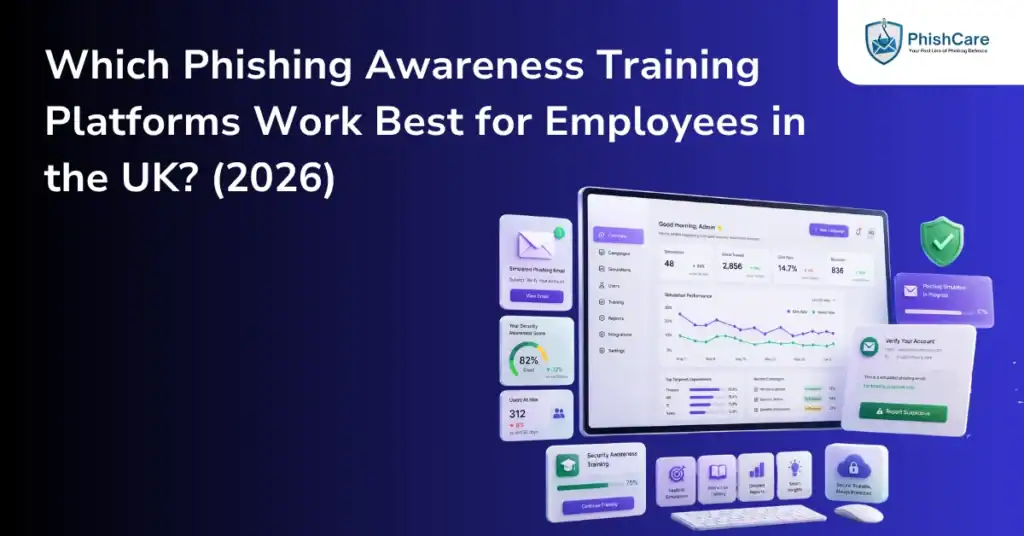
Phishing attacks targeting UK businesses have become more sophisticated, more personalised, and increasingly difficult for employees to identify. In 2026, organisations are no longer evaluating phishing awareness training platforms based only on generic video modules or annual compliance sessions. Security leaders across the UK are now prioritising measurable employee behaviour change, realistic phishing simulations, detailed reporting visibility, and continuous awareness reinforcement.
The best phishing awareness training platforms now combine phishing simulation campaigns, adaptive employee learning, reporting dashboards, compliance-friendly documentation, and real-time threat education. Whether you manage cybersecurity for a financial services firm, healthcare organisation, educational institution, retail company, or growing enterprise in the UK, selecting the right platform can significantly reduce human-risk exposure.
What UK Organisations Now Expect From Phishing Awareness Platforms in 2026
Realistic Phishing Simulations
Modern platforms now deliver highly realistic phishing simulations that replicate current attack tactics targeting UK employees across email, cloud collaboration, HR workflows, invoices, and credential harvesting campaigns.
Behaviour-Focused Training
Security teams increasingly prefer platforms that improve long-term employee behaviour instead of relying only on one-time awareness sessions or passive compliance-focused training modules.
Compliance Reporting Visibility
Detailed phishing simulation reporting can provide an additional documentation boost for organisations working towards ISO 27001, SOC 2 Type II, PCI DSS, HIPAA, and NIST CSF security awareness best practices.
In this updated 2026 comparison guide, we evaluate some of the most recognised phishing awareness training platforms used by organisations in the UK, including simulation quality, training experience, reporting capabilities, usability, scalability, and suitability for different organisational environments.
We also examine how platforms such as PhishCare are helping organisations strengthen employee awareness programs with phishing simulations, security awareness reinforcement, reporting visibility, and enterprise-focused deployment flexibility.
How We Evaluated These Phishing Awareness Training Platforms
Selecting a phishing awareness training platform in 2026 involves more than reviewing template counts or comparing basic training modules. UK organisations now expect phishing simulation platforms to support measurable security awareness improvement, employee engagement, reporting visibility, and operational scalability across distributed workforces.
For this comparison, we evaluated each platform based on practical deployment considerations commonly reviewed by security teams, IT managers, compliance leaders, and enterprise decision-makers across UK organisations.
Key Evaluation Areas Included in This Comparison
Phishing Simulation Quality
We assessed how realistic and adaptable the phishing simulation campaigns are, including email realism, attack scenario diversity, landing page customisation, credential capture simulation, and regional relevance for UK organisations.
Employee Training Experience
The effectiveness of awareness content depends heavily on engagement quality. We reviewed how platforms deliver microlearning, interactive training, multilingual awareness content, and role-based awareness experiences.
Reporting and Risk Visibility
Reporting quality is critical for demonstrating awareness progress internally. We examined dashboards, campaign analytics, user-risk scoring, executive reporting, and export capabilities used by security and compliance teams.
Deployment and Scalability
We also evaluated how easily organisations can deploy campaigns, manage employee groups, integrate with existing systems, and scale phishing awareness programs across remote or multi-office environments.
Compliance Awareness Alignment
Security awareness reporting can support organisations improving audit readiness and awareness documentation practices aligned with frameworks such as ISO 27001, SOC 2 Type II, PCI DSS, HIPAA, and NIST CSF.
Practical Suitability for UK Teams
Beyond features alone, we considered how suitable these platforms are for organisations operating within UK business environments, including ease of administration, employee adoption, and long-term awareness program sustainability.
Rather than focusing only on marketing claims or template volume, this guide prioritises practical considerations that security and compliance teams commonly evaluate before investing in a phishing awareness training platform for long-term organisational use.
2026 Comparison of Phishing Awareness Training Platforms in the UK
Different phishing awareness training platforms focus on different organisational priorities. Some are designed around large-scale phishing simulations, while others focus more heavily on behavioural learning, automation, reporting visibility, or enterprise ecosystem integrations.
Below is a simplified comparison of some of the most recognised phishing awareness training platforms used by organisations in the UK in 2026.
PhishCare
Flexible DeploymentPhishCare focuses on realistic phishing simulation campaigns, employee awareness reinforcement, and reporting visibility designed for organisations looking to improve phishing resilience across distributed teams.
- Customisable phishing simulations
- Detailed campaign reporting dashboards
- Flexible deployment for SMBs and enterprises
- Awareness reinforcement workflows
KnowBe4
Enterprise ScaleKnowBe4 is widely used by enterprise organisations for phishing simulation campaigns, awareness training libraries, automation workflows, and administrative reporting capabilities.
- Large phishing template library
- Extensive awareness training catalog
- Strong enterprise administration controls
- Broad organisational adoption globally
Hoxhunt
Behaviour AnalyticsHoxhunt focuses heavily on behavioural learning, adaptive phishing simulations, and employee engagement through gamified awareness experiences and AI-driven learning paths.
- Adaptive phishing simulation workflows
- Gamified employee awareness learning
- Behaviour-focused analytics
- Risk-based awareness insights
Microsoft Attack Simulation Training
Microsoft EcosystemMicrosoft Attack Simulation Training is commonly used by organisations already operating within the Microsoft security ecosystem and looking for native phishing simulation capabilities.
- Integrated Microsoft environment workflows
- Native simulation management
- Basic awareness experiences
- Microsoft reporting integration benefits
Proofpoint
Enterprise SecurityProofpoint is often selected by large organisations looking for enterprise-grade phishing simulation capabilities integrated with broader security operations and threat protection workflows.
- Enterprise-focused phishing simulations
- Advanced reporting visibility
- Security ecosystem integration support
- Suitable for regulated environments
Choosing the Right Platform Depends on Organisational Priorities
Some UK organisations prioritise simulation realism and reporting visibility, while others focus more heavily on employee engagement, automation, behavioural analytics, or ecosystem integrations. The most effective phishing awareness programs are typically those that combine continuous phishing simulations with ongoing awareness reinforcement rather than relying only on annual training cycles.
Why Many UK Organisations Are Exploring PhishCare for Phishing Awareness Training
As phishing attacks continue evolving across UK industries, organisations are increasingly looking for phishing awareness platforms that combine realistic phishing simulations, employee awareness reinforcement, reporting visibility, and deployment flexibility without creating unnecessary administrative complexity.
PhishCare , developed by CyberSapiens, is designed to help organisations run phishing simulation campaigns that improve employee awareness while providing security teams with actionable visibility into phishing-risk exposure and awareness progress.
Realistic Phishing Simulations
PhishCare enables organisations to run phishing simulation campaigns designed to reflect modern phishing techniques commonly targeting employees through credential theft, HR impersonation, invoice fraud, cloud login attacks, and social engineering workflows.
Awareness Reinforcement Workflows
Beyond one-time training sessions, PhishCare supports continuous employee awareness reinforcement through recurring phishing simulations and ongoing awareness engagement strategies.
Reporting and Visibility
Detailed campaign reporting helps organisations understand phishing susceptibility trends, employee interaction behaviour, reporting rates, and awareness improvement across teams and departments.
Flexible Deployment Approach
PhishCare is suitable for organisations ranging from growing businesses to larger enterprises looking for phishing awareness deployment flexibility without highly complex implementation overheads.
Supporting Security Awareness and Compliance Readiness
PhishCare’s phishing simulation reporting can provide an additional documentation boost for organisations working towards ISO 27001, SOC 2 Type II, PCI DSS, HIPAA, and NIST CSF awareness best practices where ongoing employee security awareness programs are commonly reviewed during audits and internal assessments.
For UK organisations evaluating phishing awareness platforms in 2026, the ability to combine realistic simulations, employee behaviour visibility, and ongoing awareness reinforcement is becoming increasingly important as phishing threats continue to evolve.
Why Continuous Phishing Awareness Training Matters More in 2026
Many organisations in the UK are moving away from annual awareness-only training models and adopting continuous phishing awareness programs that reinforce employee vigilance throughout the year. This shift is largely driven by the increasing sophistication of phishing attacks targeting employees through email, collaboration platforms, HR systems, cloud logins, and business communication workflows.
Modern phishing attacks often imitate trusted brands, internal departments, executives, suppliers, or cloud platforms with high levels of realism. Because of this, organisations are recognising that awareness training cannot remain a once-a-year compliance exercise. Employees require ongoing exposure to realistic phishing simulations and regular awareness reinforcement to improve recognition and reporting behaviour over time.
Employees Face Constantly Changing Attack Tactics
Attackers continuously adapt phishing techniques to mimic evolving workplace communication styles. Security awareness programs that rely only on static training modules may struggle to prepare employees for modern phishing tactics targeting UK organisations.
Behavioural Reinforcement Improves Awareness
Recurring phishing simulations help employees develop stronger recognition instincts over time. Continuous reinforcement also helps organisations identify departments or user groups that may require additional awareness support.
Reporting Visibility Helps Security Teams
Detailed awareness reporting provides organisations with visibility into phishing susceptibility trends, reporting behaviour, click rates, and awareness improvement metrics across teams and locations.
What Organisations Commonly Look for in Modern Awareness Platforms
Realistic phishing templates that reflect current attack patterns and employee communication environments.
Awareness workflows that encourage long-term employee learning instead of one-time participation.
Administrative visibility that helps IT and security teams measure awareness improvement over time.
Flexible deployment approaches suitable for remote teams, hybrid workplaces, and multi-location organisations.
As phishing attacks continue evolving across industries in 2026, organisations are increasingly recognising that phishing awareness training is most effective when it becomes a continuous employee security awareness process rather than a periodic compliance activity.
How PhishCare Supports UK Organisations Beyond Basic Awareness Training
Many organisations initially adopt phishing awareness platforms to meet internal security awareness goals, but over time they often realise that effective phishing simulation programs can also strengthen employee behaviour visibility, reporting culture, and operational preparedness against evolving phishing threats.
PhishCare is designed to support organisations looking for practical phishing simulation management, awareness reinforcement, and reporting visibility without unnecessary operational complexity. This makes it suitable for organisations ranging from growing businesses to larger enterprise teams operating across multiple locations.
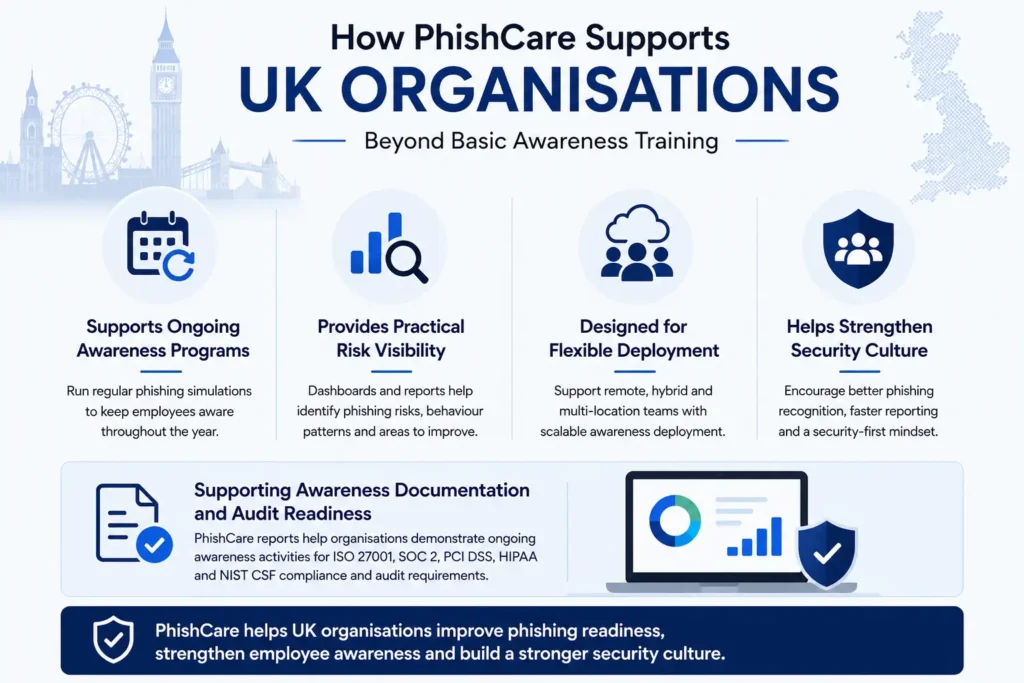
Supports Ongoing Awareness Programs
PhishCare supports recurring phishing simulation campaigns that help organisations maintain continuous employee awareness rather than relying solely on annual awareness sessions.
Provides Practical Risk Visibility
Campaign analytics and reporting dashboards help security teams identify phishing-risk trends, employee interaction behaviour, and awareness improvement opportunities across departments.
Designed for Flexible Deployment
PhishCare can support organisations with remote employees, hybrid teams, multiple office locations, and growing workforce structures that require scalable awareness deployment approaches.
Helps Strengthen Security Culture
Regular phishing awareness exercises help reinforce a stronger security-first mindset among employees while encouraging faster reporting and improved phishing recognition behaviour.
Supporting Awareness Documentation and Audit Readiness
For many organisations, phishing awareness reporting is not only valuable for internal security visibility but also for demonstrating ongoing awareness activities during internal reviews, customer assessments, and compliance discussions.
PhishCare’s phishing simulation reports can provide an additional documentation boost for organisations working towards ISO 27001, SOC 2 Type II, PCI DSS, HIPAA, and NIST CSF best practices where continuous employee security awareness is commonly reviewed as part of broader cybersecurity governance efforts.
Why UK Organisations Continue Investing in Phishing Simulation Programs
As phishing attacks continue targeting employees through increasingly convincing social engineering methods, organisations are recognising that technical security controls alone are not enough. Employees remain one of the most targeted entry points for phishing campaigns, making awareness reinforcement an important part of broader cybersecurity strategy.
Platforms such as PhishCare help organisations continuously evaluate phishing readiness, improve employee awareness behaviour, and maintain stronger visibility into phishing-risk exposure across evolving workplace environments.
What UK Organisations Should Consider Before Choosing a Phishing Awareness Training Platform
Not every phishing awareness platform is designed for the same operational requirements. Some organisations prioritise advanced reporting and enterprise integrations, while others focus more heavily on realistic phishing simulations, employee engagement, or ease of deployment.
Before selecting a platform, UK organisations should evaluate how well the solution aligns with their workforce structure, security maturity, awareness goals, reporting expectations, and long-term operational needs.
Simulation Realism
The effectiveness of phishing awareness programs depends heavily on how realistic the phishing simulations appear to employees. Modern phishing attacks increasingly imitate legitimate business workflows, cloud platforms, HR notifications, and supplier communications.
Employee Engagement Quality
Employees are more likely to retain awareness concepts when training experiences are practical, engaging, and delivered consistently rather than only during annual compliance activities.
Reporting and Analytics
Detailed reporting helps security teams monitor phishing-risk trends, employee interaction behaviour, reporting rates, and awareness improvement metrics across departments and locations.
Scalability and Administration
Organisations should evaluate how easily phishing campaigns can be managed across remote employees, hybrid workforces, multiple departments, and expanding organisational structures.
Common Challenges Organisations Face Without Continuous Awareness Training
Employees may struggle to identify newer phishing tactics that evolve beyond traditional suspicious-email patterns.
Awareness fatigue can increase when security education is delivered only through static or infrequent training sessions.
Security teams may lack visibility into employee phishing-risk exposure without measurable simulation reporting.
Organisations may find it difficult to demonstrate ongoing awareness activity during audits or security reviews.
Building Long-Term Employee Awareness Requires Consistency
The most effective phishing awareness programs are usually those that combine realistic phishing simulations, continuous reinforcement, measurable reporting visibility, and employee-focused learning experiences throughout the year. As phishing threats continue evolving in 2026, organisations are increasingly viewing awareness training as an ongoing cybersecurity initiative rather than a one-time compliance activity.
Frequently Asked Questions About Phishing Awareness Training Platforms in the UK
Below are some of the most common questions organisations ask when evaluating phishing awareness training platforms and phishing simulation solutions in the UK in 2026.

What is a phishing awareness training platform?
A phishing awareness training platform helps organisations educate employees about phishing attacks through awareness training, phishing simulations, reporting workflows, and ongoing security awareness reinforcement. These platforms are commonly used to improve employee phishing recognition and reporting behaviour.
Why are phishing simulations important for organisations?
Phishing simulations help organisations measure how employees respond to realistic phishing scenarios. They also help security teams identify awareness gaps, reinforce phishing recognition behaviour, and improve long-term employee vigilance against evolving phishing attacks.
How often should phishing awareness training be conducted?
Many organisations now prefer continuous awareness reinforcement instead of relying only on annual training sessions. Recurring phishing simulations and ongoing awareness programs generally help employees retain phishing recognition skills more effectively over time.
Can phishing simulation reports support compliance efforts?
Phishing simulation reporting can provide an additional documentation boost for organisations working towards ISO 27001, SOC 2 Type II, PCI DSS, HIPAA, and NIST CSF awareness best practices where employee security awareness activities are commonly reviewed.
What should organisations look for in a phishing awareness platform in 2026?
Organisations commonly evaluate phishing awareness platforms based on phishing simulation realism, employee engagement quality, reporting visibility, deployment flexibility, scalability, awareness reinforcement capabilities, and ease of administration.
How does PhishCare help organisations improve phishing awareness?
PhishCare helps organisations run phishing simulation campaigns, reinforce employee awareness, improve phishing-risk visibility, and support ongoing awareness initiatives through reporting dashboards and continuous phishing awareness workflows.
Content Reviewed By

Nawaz is a practising security analyst specialising in phishing simulation campaigns, employee awareness assessments, ethical hacking, and security awareness strategy development for organisations across multiple industries.
He works closely with organisations deploying phishing awareness programs through PhishCare, a phishing simulation and awareness platform developed by CyberSapiens. His experience includes evaluating phishing-risk exposure, awareness engagement trends, employee reporting behaviour, and phishing simulation effectiveness across diverse organisational environments.
His work focuses on helping organisations strengthen employee phishing awareness, improve phishing reporting culture, and build continuous security awareness practices aligned with modern cybersecurity risk environments.
View LinkedIn ProfileStrengthen Employee Phishing Awareness with Continuous Simulation and Training
As phishing attacks continue evolving across UK organisations in 2026, many security teams are prioritising phishing simulation platforms that improve employee awareness, reinforce reporting behaviour, and provide measurable visibility into phishing-risk exposure.
PhishCare helps organisations run realistic phishing simulations, strengthen employee awareness programs, improve phishing-risk visibility, and support long-term awareness reinforcement strategies designed for modern workplace environments.
PhishCare’s phishing simulation reporting can provide an additional documentation boost for organisations working towards ISO 27001, SOC 2 Type II, PCI DSS, HIPAA, and NIST CSF awareness best practices where ongoing employee security awareness activities are commonly reviewed.